
Longevity Pack

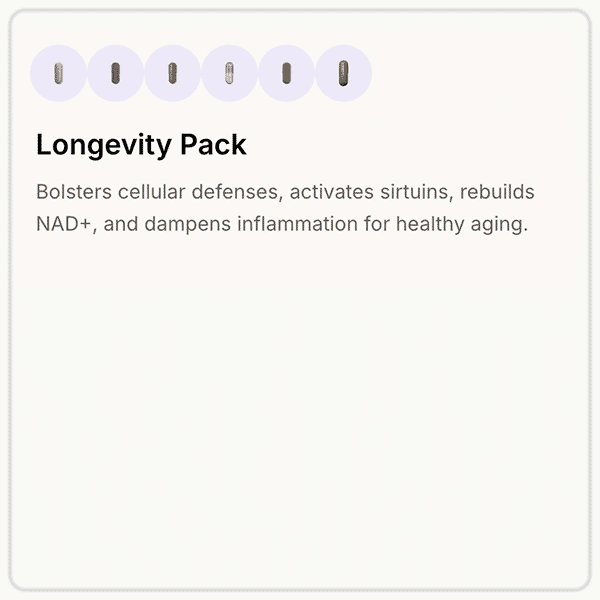
Cellular aging is a complex biological process driven by oxidative stress, mitochondrial decline, and the accumulation of cellular damage that gradually diminishes the body's ability to repair and regenerate itself. Supporting longevity at the cellular level is essential for maintaining energy, cognitive function, immune resilience, and overall vitality as we age. NAC replenishes glutathione — the body's master antioxidant — to protect DNA and combat oxidative damage, while Nicotinamide Riboside (NR) supports NAD+ production to fuel mitochondrial energy and cellular repair. Green Tea Extract and Quercetin provide powerful plant-based antioxidants that help reduce chronic inflammation associated with aging, and Resveratrol alongside CoQ10 work synergistically to activate longevity pathways, support cardiovascular health, and sustain cellular energy production.
- Supports the body's natural defenses against aging by neutralizing free radicals with NAC, green-tea EGCG, and resveratrol. - Activates vital sirtuin signaling to enhance cellular health and longevity. - Replenishes NAD⁺ levels with nicotinamide riboside, promoting efficient energy transfer. - Reduces inflammation and slows the expansion of senescent cells with quercetin and omega-3 EPA/DHA. - Protects against mitochondrial decline and slows telomere shortening, promoting overall vitality and well-being.
1. NAC: "Effects of N-acetyl-L-cysteine on lifespan, locomotor activity ..." - https://pmc.ncbi.nlm.nih.gov/articles/PMC6188487/ 2. Green Tea Extract: "Unraveling anti-aging mystery of green tea in C. elegans" - https://www.sciencedirect.com/science/article/abs/pii/S0308814624021605 3. CoQ10: "The Paradox of Coenzyme Q10 in Aging" - https://pmc.ncbi.nlm.nih.gov/articles/PMC6770889/ 4. Resveratrol: "Effects and Mechanisms of Resveratrol on Aging and ..." - https://pmc.ncbi.nlm.nih.gov/articles/PMC8289612/ 5. NR: "Nicotinamide Riboside, a Promising Vitamin B3 Derivative ..." - https://pmc.ncbi.nlm.nih.gov/articles/PMC10459282/ 6. Quercetin: "Quercetin, flavonoids and the life-span of mice" - https://www.sciencedirect.com/science/article/pii/0531556582900274
